
Healthdirect gives consumers confidence to recover at home
Published: 14 March 2025
Consumer research conducted by Healthdirect in 2024 has shown that consumers often lack the confidence to care for themselves at home when they are unwell. In some cases, this may result in a consumer heading to the emergency department.
In 2024, Healthdirect provided ‘self-care’ advice to 327,000 consumers (15.4% of all triages) across the Symptom Checker and helpline. When a consumer receives a self-care recommendation, it means it is appropriate and safe for them to care for themselves, or someone they care for, at home.
By providing easy to understand, actionable advice and relevant information on how to manage their symptoms, Healthdirect aims to ensure consumers have the confidence to manage their own recovery. As well as feeling reassured, this means a consumer can avoid heading to the doctor, or even emergency department, if they don’t need to.
How healthdirect is helping consumers to ‘self-care’ at home
Whether through the helpline or Symptom Checker, when a consumer receives a self-care recommendation, they will be supported to recover at home.
The healthdirect Symptom Checker, which is available on the healthdirect website and app, is used almost 2 million times a year. Consumers are guided through a triage process which includes a series of questions about their symptoms. Based on the information entered, they are provided advice on what to do next.
When this is to stay home and self-care, information is provided on how to take care of themselves, including links to relevant articles on the healthdirect website.
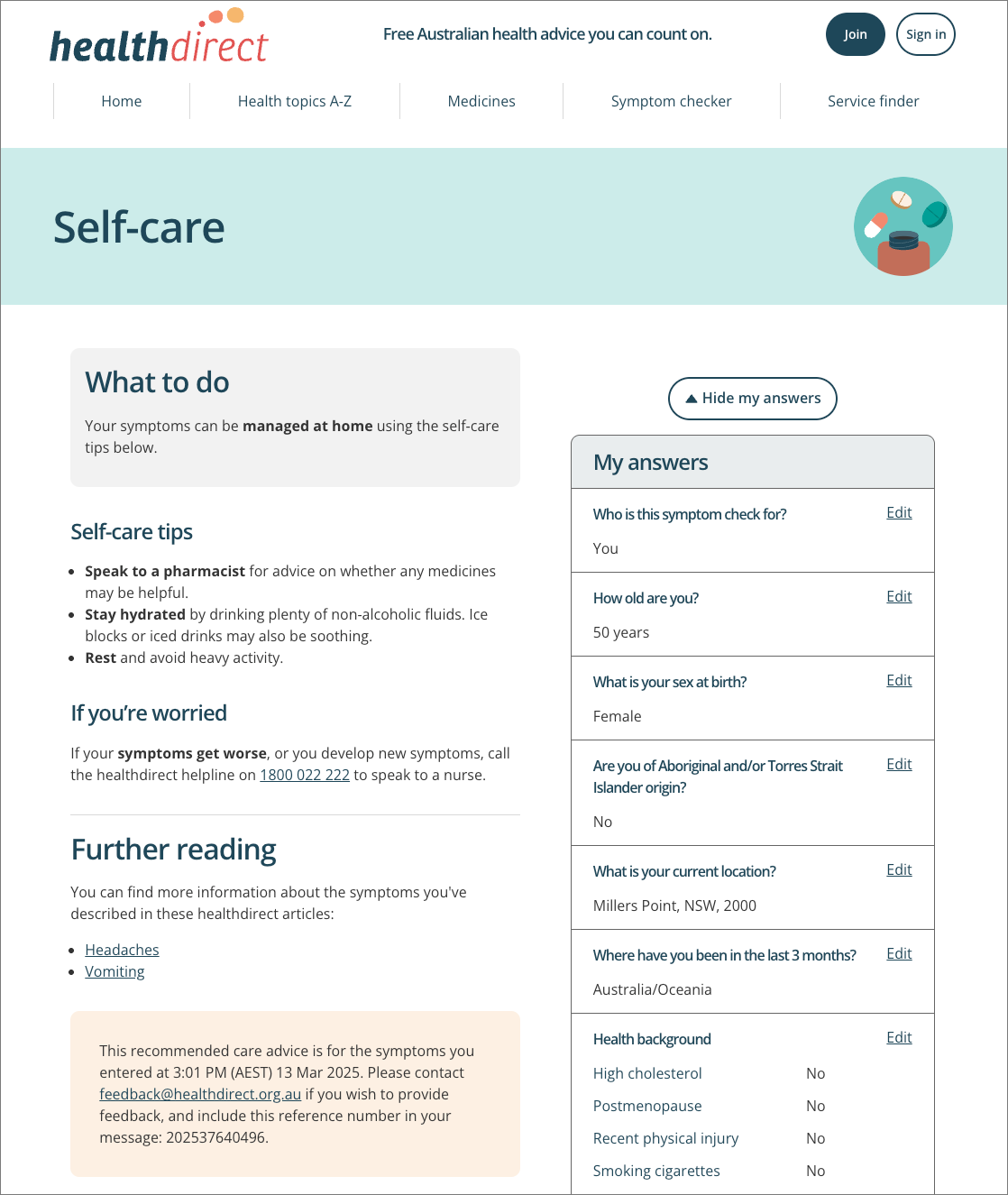
Symptom Checker users receive valuable advice on how to recover at home.
The healthdirect helpline received a total 1.4 million calls in 2024. Callers are triaged by a registered nurse and are also provided advice and information on what care they should seek. Callers who are recommended to self-care at home can be sent an SMS that includes their care advice.
The SMS provides a summary of the information the consumer provided during the triage process, links to more information about the symptoms they are experiencing, and symptoms to watch out for that may require medical attention.
Enhancing the value of self-care advice
Innovation is a key pillar of the Healthdirect Australia strategy, and supporting consumers to effectively self-care is an important focus for innovation.
In mid-2024, a two-day hackathon looked at how AI could be safely used to personalise the self-care advice provided to a user of the Symptom Checker. The hackathon trialled retrieval-augmented generation (RAG)-AI, which only draws on information from specified, trusted sources. For the hackathon, this was restricted to healthdirect’s evidence-based information, including website health articles, medicines pages and health-related concepts in the Australian Health Thesaurus.
A partnership has now been formed with the University of Sydney Health Literacy Lab (SHLL) to further understand and test the efficacy of AI-generated self-care advice. The outcomes of the research with SHLL will inform future updates to Symptom Checker.
Last reviewed: April 2025