

Understanding the NHSD architecture
Managing the data ingestion, maintenance and provision in a comprehensive directory of healthcare services is a meticulous end-to-end process. It begins with service categorisation and obtaining service data for collation.
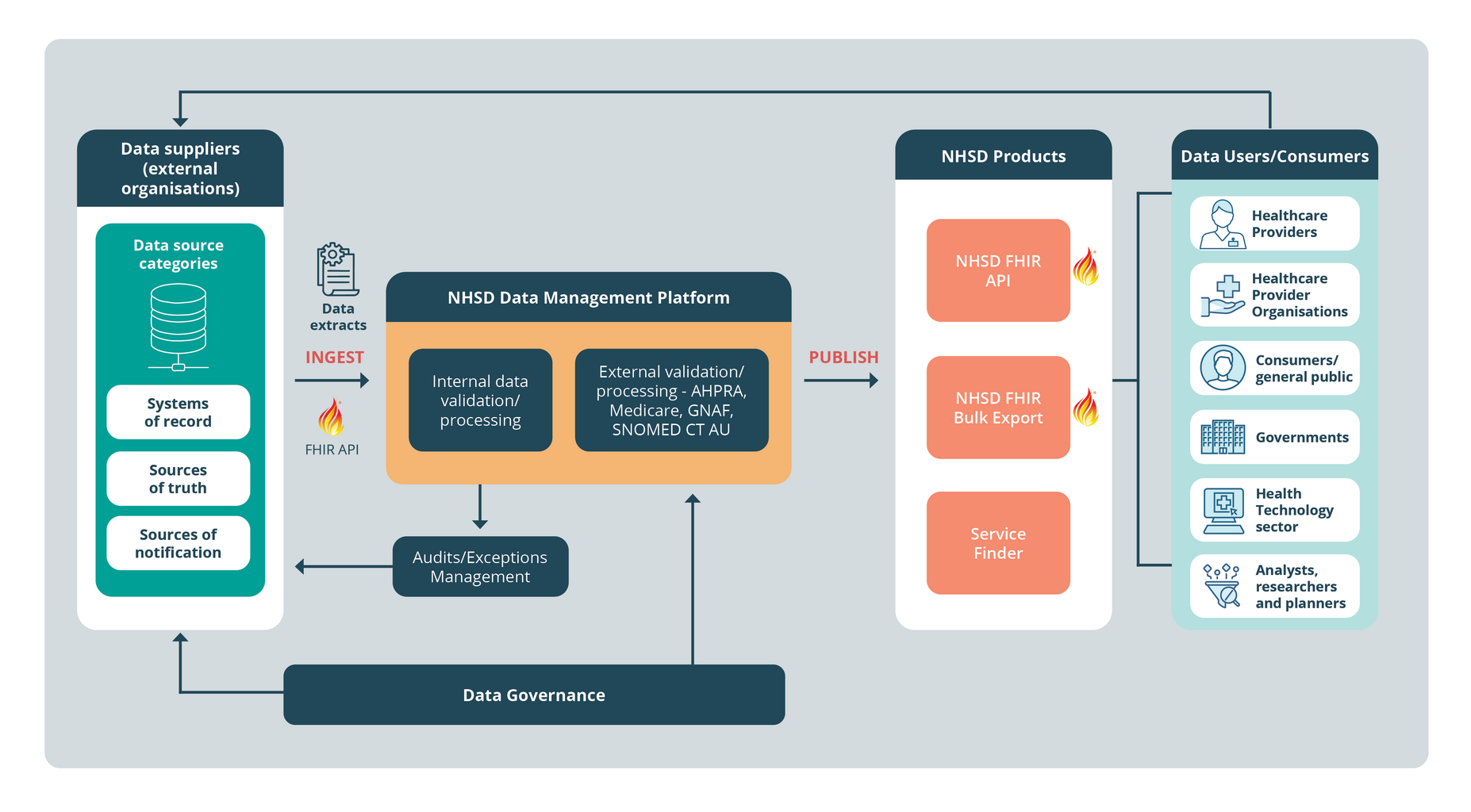
NHSD high-level architecture, end-to-end
Once data is obtained, data is validated and organised into our data model to make it easily accessible to users. Lastly, data sources are engaged through formal relationships, to provide regular updates and maintenance to ensure the directory remains current and accurate.
NHSD FHIR entity relationships
The diagram below shows the NHSD FHIR entity relationships from the perspective of the Healthcare Service Resource and is followed with a description of each entity.
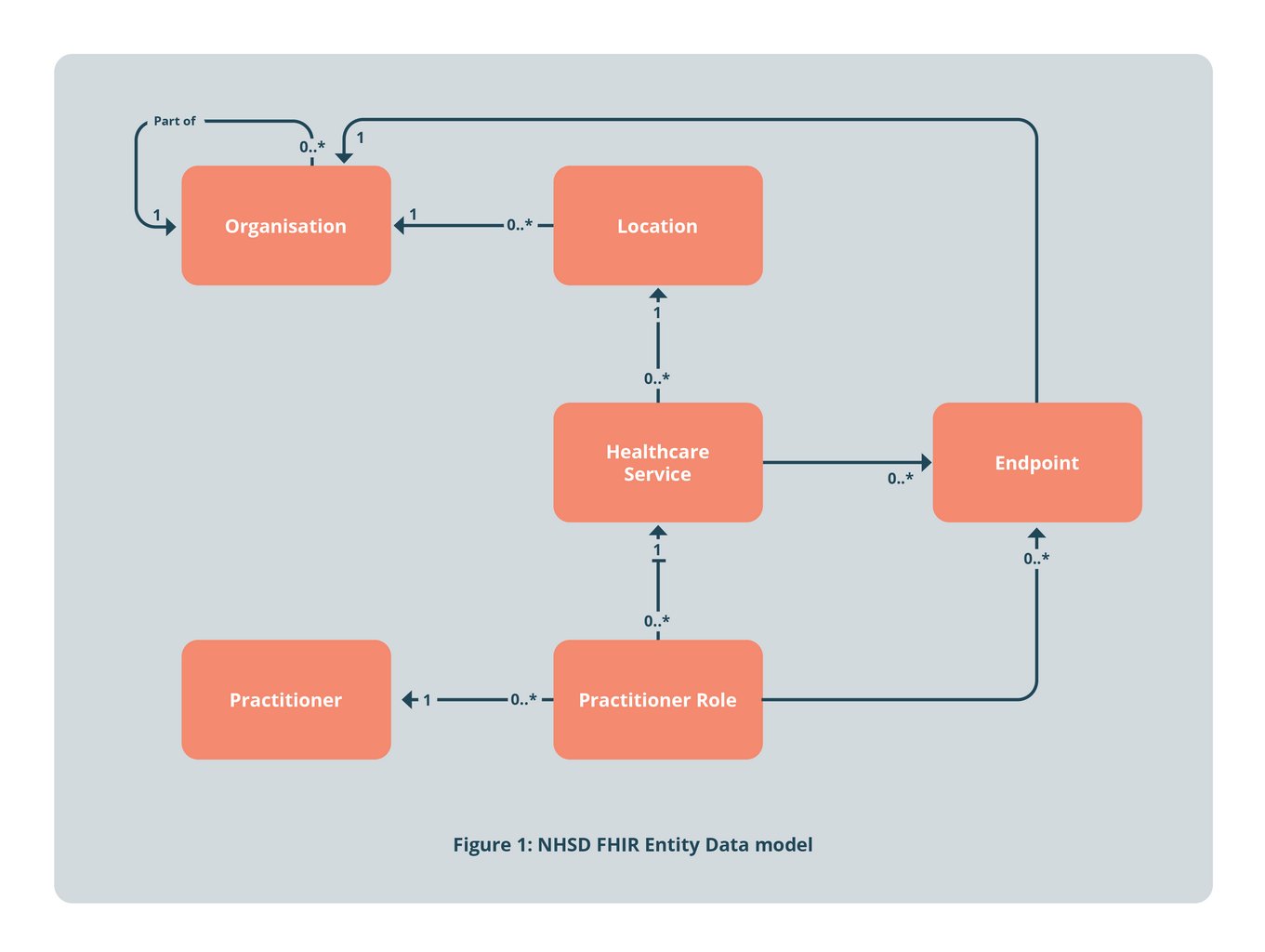
NHSD FHIR entity data model
Organisation
An Organisation must have at least one Location, which provides address or coverage information for the Healthcare Service. The Location also provides context for how the service is delivered, whether this is at a physical location, provided as services in the home or virtually.
Location
An Organisation must have at least one Location, which provides address or coverage information for the Healthcare Service. The Location also provides context for how the service is delivered, whether this is at a physical location, provided as services in the home or virtually.
Healthcare Service
The Healthcare Service entity is at the core of the NHSD’s data architecture. Healthcare services are delivered at a Location by an Organisation. In a provider directory this allows the association of secure messaging endpoints with the healthcare service and thus a channel for delivery to that service.
Practitioner Role
A Healthcare Service is delivered by a Practitioner Role, which can be filled by a specific Practitioner who is working in that role at a point in time. The Practitioner provides details of an individual who delivers services in one or more Practitioner Roles.
Practitioner
Practitioner is the individual person that is delivering the health-related service at a Healthcare Service under at least one Practitioner Role.
Endpoint
A Healthcare Service or a Practitioner Role may have secure messaging endpoints. Endpoints ensure secure electronic messages, such as discharge summaries and referrals, are delivered to the correct services.
An example of how organisations may be structured in the NHSD is represented in the diagram below.
In developing the FHIR model for the NHSD the following assumptions were made about the relationship between the FHIR Resources. It should be noted that the Healthcare Service is the core of the NHSD data.
- An Organisation provides a Healthcare Service at a Location;
- A Healthcare Service is provided by a Practitioner at a Location; and
- The data model supports n-levels of organisational (part of) relationships.
For further information on our FHIR data model, download
An example of how organisations may be structured in the NHSD are diagrammatically represented below.
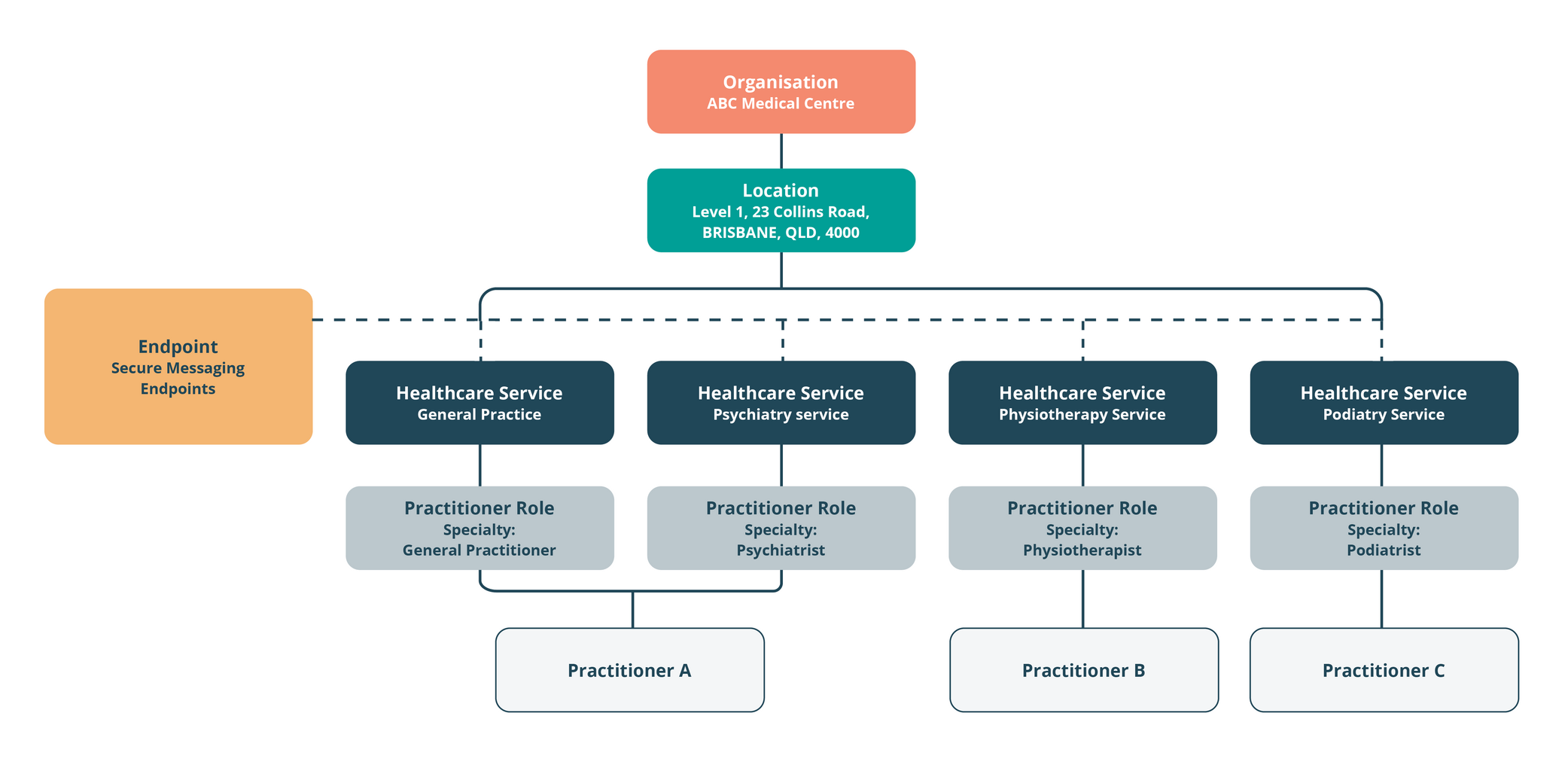
NHSD organisations structure example